List Of The Fellows And Members Of The Royal College Of Physicians Of London
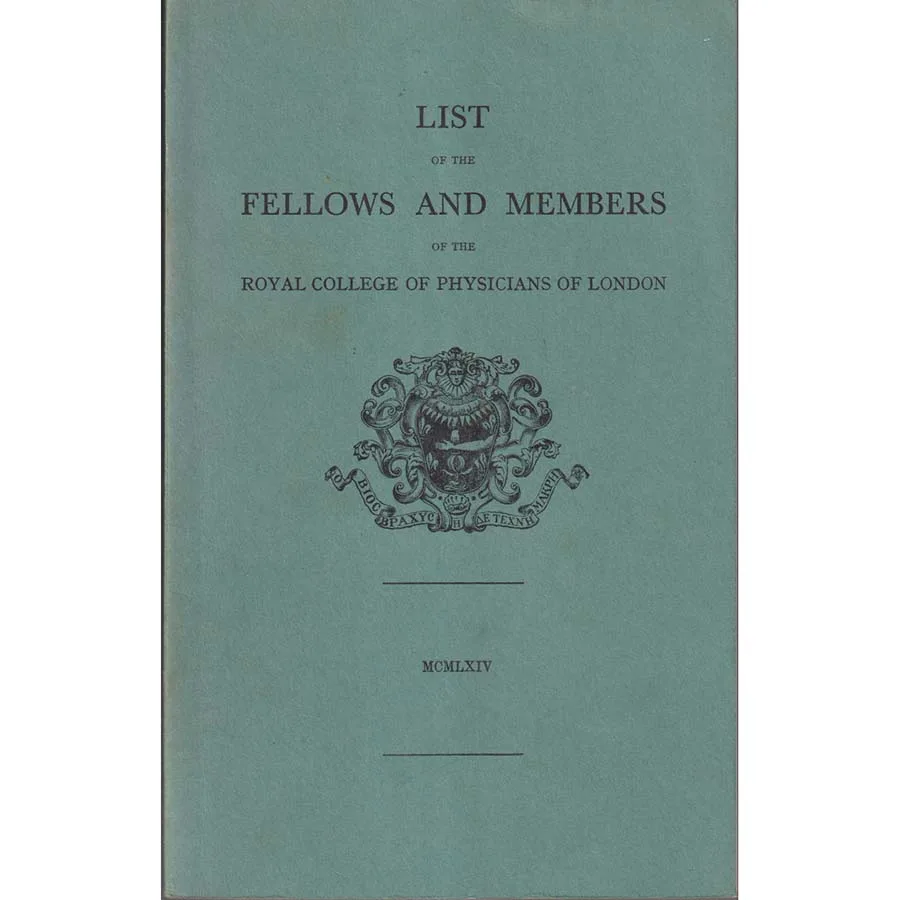
Publisher: Royal College of Physicians
Format: Paperback
ISBN: none
The medical profession has always possessed an impressive enthusiasm for titles, qualifications, distinguished institutions and the careful arrangement of letters after people’s names. Indeed, by the time a sufficiently accomplished physician has finished introducing himself, the patient may well have recovered, deteriorated or decided to consult somebody with a shorter surname. Fortunately, the Royal College of Physicians of London has spent centuries maintaining a certain order among the nation’s medical elite.
List of the Fellows and Members of the Royal College of Physicians of London (1964), published by the Royal College of Physicians itself, is a fascinating official record of the men and women who belonged to one of Britain’s oldest and most prestigious medical institutions during the mid-twentieth century.
Founded in 1518 under the authority of Henry VIII, the Royal College of Physicians has played an important role in the development of British medicine, professional standards and medical education. Its history stretches across centuries of extraordinary scientific progress, from the days when bloodletting was considered a respectable treatment to the modern discovery that patients generally prefer to retain their blood whenever possible.
This 1964 directory records the College’s professional membership at a particularly interesting moment in medical history. The National Health Service was still relatively young, new medicines and technologies were transforming clinical practice, and Britain was entering an era of increasingly sophisticated medical specialisation.
Behind the names and professional details lies a remarkable collective history. These were physicians working in hospitals, universities, research institutions and medical practices, contributing to the healthcare of a nation undergoing enormous social and scientific change.
Some would have enjoyed distinguished careers, made important discoveries or helped shape the development of particular medical specialties. Others may have spent their professional lives performing the rather less glamorous but equally necessary task of examining patients, diagnosing illnesses and attempting to explain complicated medical conditions to people who would much rather not have developed them.
For genealogists, medical historians and researchers, directories of this kind provide valuable contemporary evidence of professional status and institutional affiliation. An individual who appears merely as a name in an old family letter or hospital document may be identifiable within the membership records of a major professional institution.
There is something wonderfully reassuring about the formality of such publications. Before searchable databases, professional networking websites and elaborate online profiles, the medical establishment could establish who belonged to its ranks simply by publishing a book.
Published in 1964, this volume is also an appealing historical snapshot of British medicine, preserving a record of professional membership before subsequent decades brought enormous changes to medical practice, training and administration.
Condition: Fine. This original 1964 Royal College of Physicians publication is in particularly well-preserved condition, showing minimal signs of age or handling. A notably tidy survivor for a volume that has passed through more than six decades of medical history.
Offered by Crappy Old Books, where we have enormous respect for the medical profession, particularly those members who can explain a complicated diagnosis without employing seventeen unnecessary Latin expressions.
No ISBN, naturally. In 1964, distinguished medical institutions apparently considered their names sufficient identification, an attitude that seems entirely reasonable for an organisation established during the reign of Henry VIII.
An interesting specialist volume for medical historians, genealogists, collectors of institutional publications and anyone researching the professional world of British medicine in the 1960s.
A book containing an impressive collection of doctors, although regrettably not one of them is available to offer an appointment.
Keep browsing: See more Academic books Other books by Royal College of Physicians